Then Again I Usually See Ums the Same as a Neonazi
Fact-checking Putin's claims that Ukraine and Russia are 'one people'
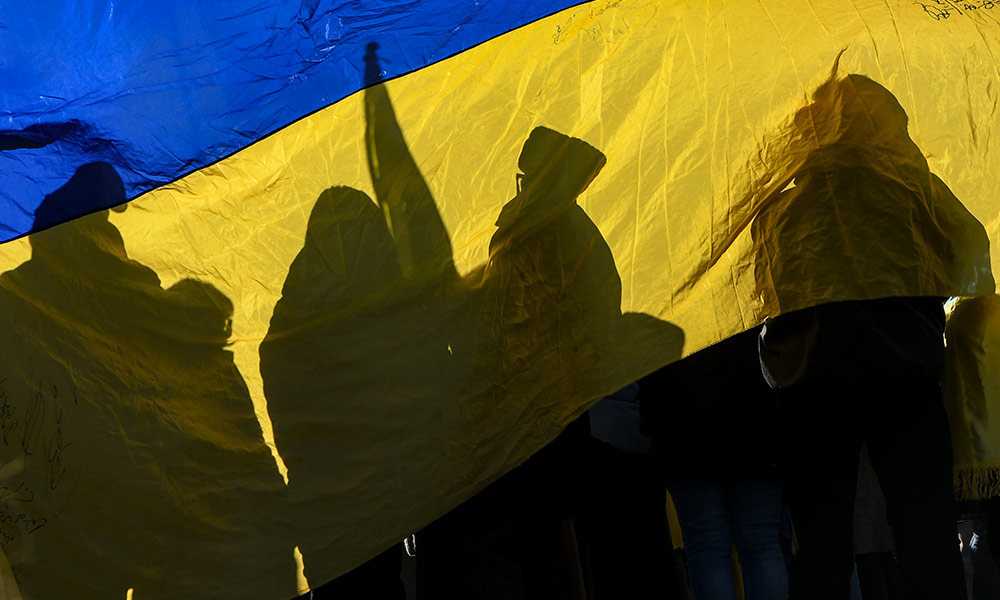 Demonstrators assemble in Washington, DC, to protest Russian federation's invasion of Ukraine. Rochester historian Matthew Lenoe examines some of the claims Vladimir Putin has fabricated to justify the invasion. (Getty Images photograph)
Rochester historian explains how Ukraine history is intertwined with Russian federation's—simply also with that of many other nations, empires, ethnicities, and religions.
"It'due south a complicated history. Just I want to be clear that what's going on in Ukraine now is a brutal act of aggression with absolutely no justification," says Matthew Lenoe, an associate professor of history at the Academy of Rochester, who is an expert on Russian and Soviet history, Stalinist civilisation and politics, the history of mass media, and Soviet soldiers in World State of war II.
Rochester voices: Washington Postal service
In an analysis for the publication's "Made past History" section, Matthew Lenoe explains the dangers of mistakenly blaming Putin's invasion on the "3rd Rome" concept.
- Read the article online at the Washington Mail (subscription required) or MSN.
While the history of the Ukrainian state probably cannot be traced back whatever before than 1918, Lenoe says "to be clear—today Ukraine is a nation state" where polling in elections indicates that the "vast majority of Ukrainians" want to preserve their independence.
Russian President Vladimir Putin has made several dubious historical arguments, most notably in his 5,000-word essay "On the historical unity of Russians and Ukrainians," published on the Kremlin's website in July 2021. In information technology, he elaborates on his assertion that Ukrainians and Russians are "one people" every bit a precursor to and defence of Ukraine'south invasion.
For example, Putin claims that Ukraine didn't exist as a separate state and had never been a nation. Instead, he argues, Ukrainian nationality was always an integral function of a triune nationality: Russian, Belorussian, and Ukrainian. Putin besides writes that Russians, Ukrainians, and Belarusians share a common heritage—the heritage of a realm known equally Kievan Rus (862–1242), which was a loose medieval political federation located in modern-day Belarus, Ukraine, and part of Russia.
"When Putin says this is the heritage of these three Slavic peoples—in one sense, he's not wrong. But there'due south no continuous line to be traced from this loose river confederation to the Russian state. And at that place's also no continuous line to be traced from this loose confederation to the Ukrainian land," says Lenoe, who is the author ofCloser to the Masses: Stalinist Civilisation, Social Revolution, and Soviet Newspapers (Harvard University Press, 2004) and The Kirov Murder and Soviet History (Yale University Printing, 2010). He is currently finishing his third book, tentatively titled Emotions, Experience, and Apocalypse in the Crimson Army, 1941–1942 .
Ukraine, for its part, also points in its declaration of independence to a continuously existing state from grand CE. Says Lenoe, "Today, both Russians and Ukrainians are making claims about their direct descent from Kievan Rus that are simply mythical and wrong."
Over the class of centuries, the surface area that is today Ukraine has been alternatingly swallowed up, controlled, or taken over past the Mongol Empire, afterward the Smooth-Lithuanian Commonwealth, the Austria-hungary, and the Russian Empire, while Crimea was at one betoken a client state of the Ottoman Empire. Between the Globe Wars, portions of western Ukraine were ruled by Poland, Romania, and Czechoslovakia.
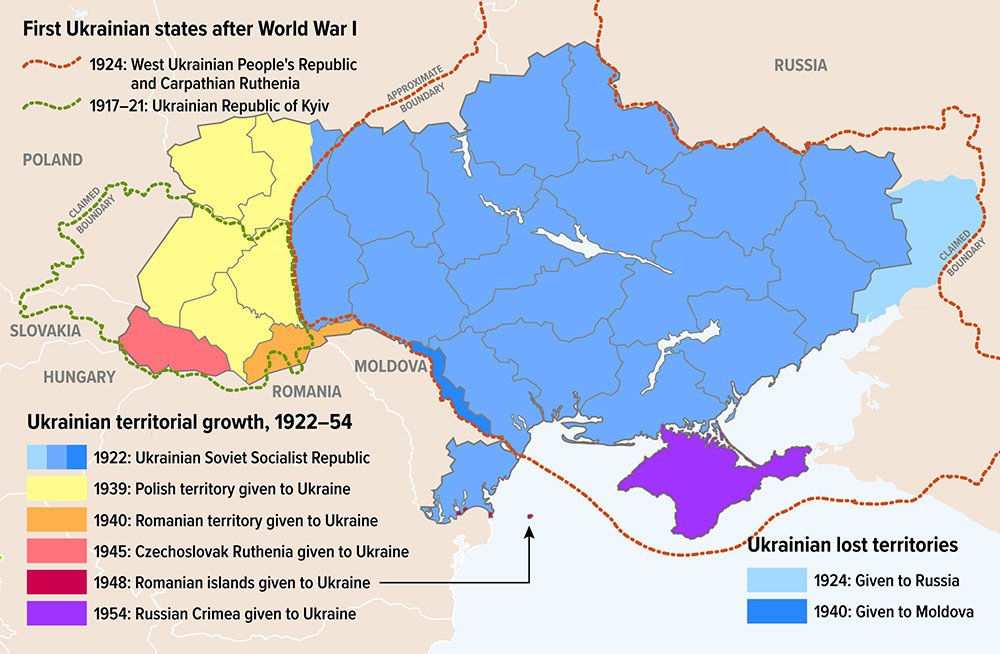
Ukraine's waxing and waning territory in the first half of the 20th century alone is "complicated and complex," says Matthew Lenoe. (University illustration / Michael Osadciw)
In brusque, Ukraine's territorial and indigenous history is "complicated and complex," Lenoe says. Of course, its history is closely intertwined with Russian history, he adds. Just it's also intertwined with Shine history, with the history of the Greek Orthodox Church, even Romanian history, and the history of the Turkic peoples on the Eurasian Steppe.
Here the Rochester historian fact-checks several of Putin'due south historical claims and discusses the ideas of nationhood and statehood, particularly with regard to Ukraine.
Q&A with Matthew Lenoe
What do historians mean by "nation" or "nationhood"?
- Opposite to popular belief, a nation is not something that has existed for centuries or millennia, with its origins in the distant past.
Lenoe: Historians don't retrieve of nations every bit existing from time immemorial. Instead, nations sally from a procedure that is sometimes very deliberate. Often the birth of a nation goes hand-in-mitt with people's increased literacy, the instituting of universal schooling; a country has defined boundaries, a primal hierarchy that is professionalized, and it is not the retinue of a noble. 1 of the legacies of the Enlightenment is the idea that every nation deserves a state.
When did Russian federation and Ukraine first emerge as states?
- The Russian land emerged effectually the 1450s. Ukraine equally a state didn't exist until the early 20th century.
Lenoe: The history of the Russian state, equally opposed to the nation, can be traced back to roughly the 1450s in a principality chosen Muscovy. Meanwhile, the history of the Ukrainian state probably cannot be traced back any earlier than 1918. So, to say that there was a Ukrainian nation in 1000 CE is an anachronism. There was no Ukrainian nation, just as there was no Russian nation in g CE.
"Putin claims that in that location'southward not a Ukrainian history separate from Russian. Simply that's non true."
Mass Ukrainian nationalism emerged out of the traumas of the 20th century. Like Ukraine, at that place are plenty of states in Europe at present that don't have a long tradition of statehood. Putin claims that at that place's not a Ukrainian history split up from Russian. But that'due south not true. Amid the speakers of Ukrainian and in the lands now comprising Ukraine, there were many dissimilar experiences. They belonged at times to different states and realms. Just there was interaction between Ukrainian speakers throughout much of this history, and they adult a mutual identity, peculiarly after the mid-19th century.
What made Ukraine historically a place of "borders and mixing"?
- Ukraine is an area of various ethnicities, including nomads, absent of clear religious or physical boundaries.
Lenoe: The discussion "Ukraine" derives from a Slavic root, which can hateful "frontier," "edge," "border," or "outlands." It has e'er been a place of borders and mixing, although the country itself didn't exist however, including the edge between the steppe and the forest zone, which is extremely important in terms of the sorts of people who lived hither. You have the mixing of many ethnicities: different Slavic ethnicities, Turkic peoples. Eventually, y'all become Jews, Germans, people who come up to be called Poles, Greeks, people who spoke Iranian languages, and so on. Religious boundaries were equally fuzzy betwixt the Orthodox Christian Church and the Catholic Christian Church building, with Islam thrown in.
What role practice the Cossacks play in Ukrainian history and statehood?
- Through rebellion, they established a Ukrainian Cossack state, the Cossack Hetmanate, that existed from 1648 to 1764.
Lenoe:The Cossacks were folks who lived in the steppe and started probably equally multiethnic warrior bands; they pretty quickly became Orthodox and largely Slavs. They were fishermen or agriculturalists; they often lived on protected fortresses and rivers, and a lot of their living was made by raiding the Crimean Tartars and Ottomans.
The whole area of the steppe was known as the wild fields and was a kind of free zone. The Cossacks thought of themselves as free men. That'due south very important. They practiced early on a form of warrior commonwealth. Controlling the steppe was something both Moscow and Poland wanted to do. And they both tried to use the Cossacks: Moscow hired them as mercenaries and supplied them with weapons, and the Smoothen-Lithuanian Commonwealth would exercise the same.
Important to note is Bohdan Khmelnytsky, a Cossack who lead a rebellion confronting the Shine Democracy in 1648 and 1649 that resulted in the creation of a Ukrainian Cossack realm, known equally the Hetmanate. You can't quite trace the modernistic Ukrainian state to this, but Ukrainians remember it as an of import part of their heritage. Khmelnytsky had to maneuver between Russia, Poland, and the Ottoman Empire to maintain independence. In the cease, the Hetmanate threw in its lot with the Russians, under heavy pressure. Putin claims that the Russians "liberated" the Cossacks, but it was actually a forced "choice."
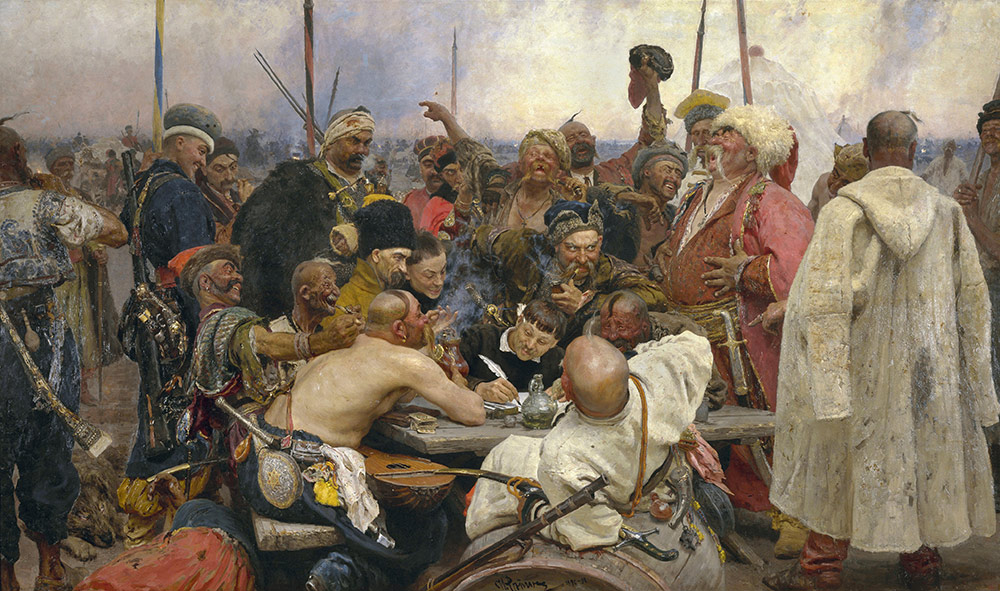
Reply of the Zaporozhian Cossacks, a famous painting past Ilya Repin (1844–1930), depicts the Ukrainian ideal of wild, free Cossack warriors. The oil painting supposedly shows a scene from 1676, based on the legend of the Cossacks' sending an insulting respond, laced with vulgarities and profanities, to an ultimatum by the Sultan of the Ottoman Empire, Mehmet Four, that demanded that the Cossacks submit to Ottoman rule. (Wikimedia Commons image)
Putin claims that a separate Ukrainian identity is an artificial invention. Is he right?
- Putin is about a quarter right—in part because he is aware of modern scholarship on Ukrainian identity.
Lenoe: Putin is referring to a myth that a separate Ukrainian identity was created in the mid-1800s by Poles and a few "misguided" Ukrainian intellectuals.
At present, every bit with a lot of what Putin or somebody in his entourage says, he's aware of certain kinds of modern scholarship. At that place's a quarter truth here. In the mid-19th century, when intellectuals start debating identity and assemble a Ukrainian grammer, the peasants couldn't take cared less: they were almost entirely illiterate, they would not have thought of themselves as Ukrainian, they would have thought of themselves equally Orthodox people, identified past their hamlet, maybe identified with their position in life—as a peasant or townsperson. And the same thing held for Russia, perhaps with the divergence that after the Napoleonic invasion of 1812, nobles were starting to think of themselves strongly as Russian.
Past 1816, you lot'll find the ancestry of a written Ukrainian linguistic communication, coupled with an increasing romantic involvement in the Cossacks as noble pirates, adventurers, and fighters for freedom. And while the Cossacks are a retentivity that both Russians and Ukrainians share, they go central to Ukrainian identity. By the mid-19th century, you have intellectuals and writers, such as Taras Shevchenko (1814–1861) and Mykola Kostomarov (1817–1885), drawing on what they see as a Ukrainian legacy that goes back to the Cossack Hetmanate and, indeed, they're saying back to Kievan Rus. Contra Putin, these folks are non Poles, merely Ukrainians living inside the Russian Empire.
Kostomarov actually is one of the founders of Ukrainian nationalism. His vision is interesting, because he was also what we might call a "liberal." He said that the Ukrainian people are naturally costless people, that they will win their liberty from the Russian Empire, and that they will lead the globe's peoples to freedom.
Putin claims that the German Empire and Austrian-Hungarian Empire essentially created a modern Ukraine. Is that true?
- The Central Powers were the World War I coalition that consisted primarily of the German Empire and Austro-hungarian empire. Putin's claim that this coalition sponsored an contained Ukraine is wrong.
Lenoe: That'southward basically a agglomeration of nonsense. Putin is basing that on the fact that Ukrainian leaders, at a detail moment, sought the support of the Central Powers to salve their independence movement from the Bolsheviks. Merely at that betoken, in that location had been already a three-generation-long movement for Ukrainian autonomy or independence. And then, this claim is nonsense.
Is modern Ukraine the product of the Bolshevik era, every bit Putin claims?
- Putin takes to an extreme the nuanced scholarship about the Soviets' sponsoring different nationalities, including Ukraine, which after separate from the Soviet Union.
Lenoe:Early Bolshevik nationalities policy really sought to build different nations culturally, because they wanted to caput off the threat of nationalism to Communist power. They wanted to make sure they didn't incur nationalist rebellions. Rather than relying on brute force, the idea was to take unlike republics that would be politically controlled by Moscow but would have cultural autonomy. In a sense, yous can talk most a continuous Ukrainian country from 1918 onward, because nominally Ukraine was a kind of sovereign land within the Soviet Federation.
"Putin has created his own worst nightmare. If in that location was weak Ukrainian nationalism before, information technology will never exist weak over again. Ukraine will become similar Poland, which you can accept over, but never hold."
Now, equally we know, in a lot of ways that idea of autonomy was imitation, simply it'due south still worth noting. Initially, the Bolsheviks actually promoted Ukrainian language and culture by creating a network of Ukrainian, rather than Russian, language schools. By the 1930s, of course, policies toward nationalities and minorities became very repressive nether Stalin. However, in many ways policies promoting non-Russian national identities remained in place throughout Soviet history. And then, Putin makes a claim here that the Bolsheviks with their nationalities policy actually created new nations.
Putin is using a much more than nuanced scholarship in a creature strength way. Recent scholars have argued that the Soviets created to some extent their ain nationalities trouble by sponsoring these different nationalities, which later split from the Soviet Matrimony. And Putin is taking that indicate—he or somebody in his circle is aware of the scholarship—to an extreme, saying in that location was no Ukraine until the Bolsheviks created information technology by sponsoring Ukrainian civilization. Equally nosotros've seen, that's a false claim.
Did Ukrainians welcome Nazi Germany's invasion in 1941?
- In the far western parts of Ukraine—yes, but only at first. It apace became articulate that the Nazis were even worse than the Stalinists.
Lenoe:One of the stories you'll hear is that when the German troops came, Ukrainian peasants were waving swastika flags, giving them staff of life and flowers. The Ukrainian peasants hated Soviet collectivization, and so in the far westward, Germans were probably welcomed. Although it'due south not clear what happened in the rest of Ukraine, it chop-chop became clear that the Nazis were even worse than the Stalinists.
Ukrainians as a whole hated the Centrality occupation. There was, however, a fairly widespread collaboration among Ukrainians in the Holocaust, based on long standing anti-Semitism. No question, in that location were police units that Ukrainians volunteered for which were involved in the mass murder of Jews. This is troubling now because both Poland and Ukraine, where there was all-encompassing Nazi collaboration, have passed memory laws that aim to ban give-and-take of that collaboration—and Ukrainian nationalists really don't desire to talk about it.
Of course, it's too true that there are almost 2,500 Ukrainians who have been identified by Yad Vashem [the Globe Holocaust Remembrance Center] as belonging to "the righteous amidst the nations"—an honorary designation for non-Jews who aided Jews during the Holocaust.
What most Putin's merits that Ukraine needs to be denazified today? Does Ukraine have a neo-Nazi problem?
- Putin'southward claim of fighting for denazification in Ukraine distorts history. It's another pretext to justify his invasion.
Lenoe: It's a very complicated situation. The retentivity of the Holocaust and the far-right OUN, the Organisation of Ukrainian Nationalists that was founded in 1928, is part of why Putin claims there are fascist or neo-Nazi elements in Ukraine. Indeed, information technology'south troublingly that in 2012 Stepan Bandera [an antisemitic Ukrainian ultranationalist leader involved in terrorist activities and a known Nazi collaborator] was officially named "Hero of Ukraine" by the government. Notwithstanding I should also annotation that there was a lot of liberal opposition to this in Ukraine. And yes, it's truthful that there was and is a kind of a Ukrainian national/neo-Nazi motility that looks back, for instance, to the SS in World War Ii as a positive memory. The election support for those people peaked in 2012 at about ten percent; since then it's dropped to beneath 5 percent.
"[Putin] is a desperate man: Russia'south international position before this invasion was weak, and now it's far more so."
In Volodymyr Zelensky, Ukraine at present has a Jewish president who lost relatives in the Holocaust. And so, yes, there is anti-Semitism in Ukraine, merely information technology'southward non overwhelming. And Putin's claim that the Jewish Zelensky is a kind of neo-Nazi—well, nosotros're getting into some really preposterous territory here.
Do you think Putin believes his own statements on Ukraine's history?
- Yes, says Lenoe.
Lenoe: I recall that Putin believes what he has said. He was educated in this view of Ukraine when he grew upwardly in the Soviet Union, and he puts this together with his understanding of the connected being of NATO after the Soviet collapse, and US hegemony, and combines that with this thought that Ukraine is an integral office of Russia. And, he says, if Europeans are going to aggrandize into Ukraine—whether as European union members or NATO—that's basically NATO's invading Russia.
He's a desperate man: Russia's international position earlier this invasion was weak, and now it's far more so. Putin has created his own worst nightmare. If there was weak Ukrainian nationalism before, it will never be weak again. Ukraine will become like Poland, which y'all can accept over, but never concord. He has inadvertently unified the West, along with countries like Japan and Korea, in an extraordinary bloc against Russia. Just to give you an example of how extraordinary this: the Germans have decided to increment their defense spending essentially. This was unthinkable before Ukraine's invasion, partly because of Federal republic of germany's heritage of World War Ii.
How would you depict Putin'due south conclusion to invade?
- It'due south an irrational move driven by Putin'due south perception of a threat to Russia.
Lenoe: This is the act of a desperate man who actually thinks there is an existential threat to Russian federation because of a possible NATO expansion. And it's his hubris. Information technology'southward a sign that people aren't necessarily rational, and that simple-minded versions of rational option theory don't work. This is a motility that's irrational on every level, that might fifty-fifty pb to Putin's being overthrown by, for example, a military insurrection. In a sense, it'south his emotional attachment to these kinds of historical claims and likewise a sense that the collapse of the Soviet Union was a humiliation that must be avenged.
Read more
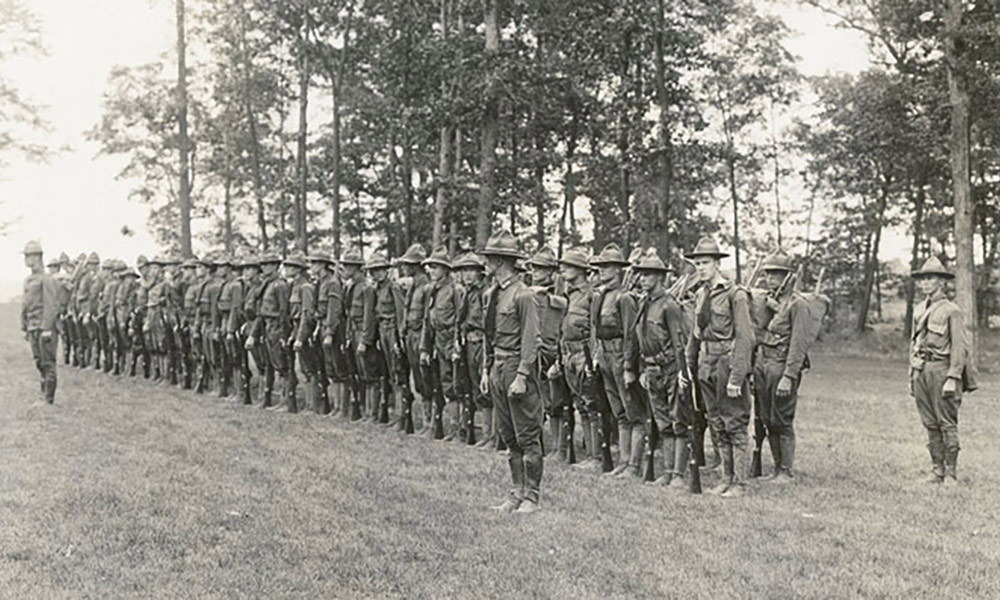 Why did the The states enter World War I?
On April 6, 1917, Congress voted to declare war on Germany. Rochester political scientist Hein Goemans explains why Germany was willing to risk American entry into the war.
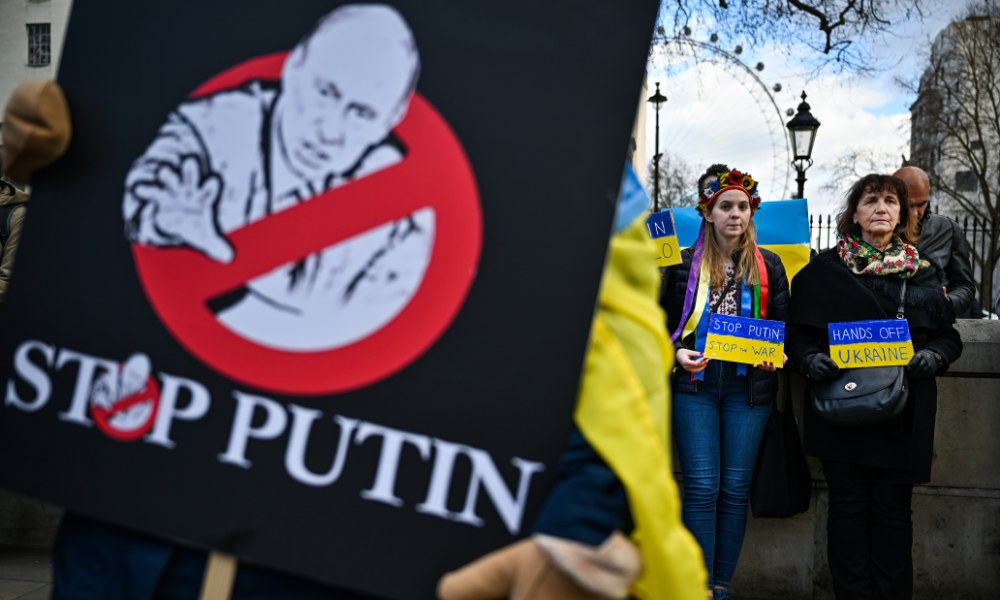 Why is Putin invading Ukraine?
Political scientist Hein Goemans, Rochester's expert on international conflicts, explains why Ukraine's fate may be tied to Putin's survival—and why this is the most dangerous geopolitical situation since Earth War Ii.
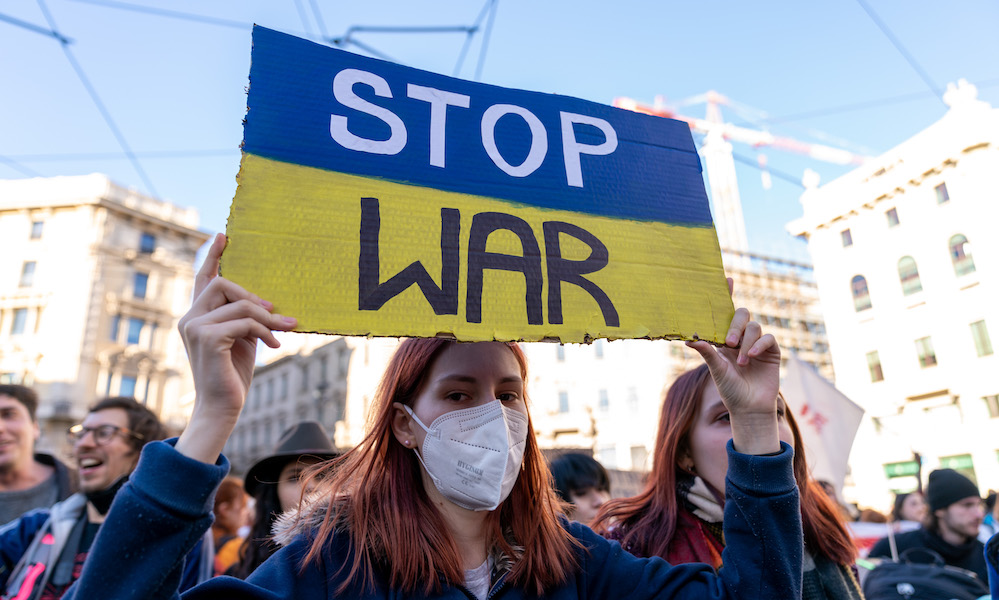 How to terminate the war in Ukraine
Rochester political scientist Hein Goemans, an adept on state of war termination, applies possible scenarios to Russia'southward invasion of Ukraine.
Category: Society & Civilization
lineberryotile1991.blogspot.com
Source: https://www.rochester.edu/newscenter/ukraine-history-fact-checking-putin-513812/
0 Response to "Then Again I Usually See Ums the Same as a Neonazi"
Post a Comment